[MODE]FRACTIONAL CTO

Your technology needs a CTO who can still build.

I work directly with founders and CEOs to turn technical ambiguity into working systems. I set the direction, lead the people and vendors, make the hard architecture calls, manage risk, and personally enter the code or infrastructure when direct action is the fastest way to protect the outcome.

My judgment is grounded in more than two decades of personally building, operating, securing, diagnosing, and rescuing the kinds of systems I ask others to deliver.

Product, cloud, security, SaaS, AI, automation, revenue systems, and data architecture.

INSPECT THE EVIDENCE

Not a strategy handoff. Not ticket-based development. One accountable technology leader from decision through production.

Mandate THE MANDATEHOW THE WORK RUNS
  1. READ THE BUSINESS

    01

    Goals, constraints, people, money, risk

  2. MAKE THE DECISION

    02

    Thesis, architecture, build or buy, sequence

  3. LEAD THE BUILD

    03

    Team, vendors, cadence, critical path

  4. PROVE THE RESULT

    04

    Working production, evidence, handoff

ONE OWNER ACROSS ALL FOUR STAGES

[FIT] :: THE INFLECTION POINT

The company has reached a point where technology needs an owner.

Founders usually call me after technology stops being a department-level concern and becomes a company-level decision. The trigger may look technical. The cost is usually operational, financial, or strategic.

  • 01

    There is no senior technical owner.

    The roadmap, developers, agencies, vendors, and infrastructure all exist, but nobody has the authority and range to make them one system. I take ownership of the decisions, sequence, standards, and result.

  • 02

    Growth outran the stack.

    Manual work, duplicate data, fragile integrations, and operational exceptions are consuming the company. I identify the constraint, decide what to buy or build, and lead the path to a system that can carry the next stage.

  • 03

    The team can build, but cannot converge.

    Capable people are shipping in different directions. I establish technical authority, architecture, priorities, delivery cadence, and decision rights without treating the existing team as the problem.

  • 04

    A consequential deadline is approaching.

    A launch, migration, fundraise, due-diligence review, audit, acquisition, or major client commitment has removed the margin for technical ambiguity. I create the decision package and own the execution path.

  • 05

    AI moved from opportunity to risk.

    The company needs more than a model demo. I choose the right use case, design the data and security boundaries, build or lead the production system, and make the output observable and reviewable.

  • 06

    The previous build did not survive reality.

    A product, integration, migration, or vendor engagement stalled or failed. I establish what is actually true, stabilize the critical path, and decide what to preserve, repair, replace, or stop.

Rescue :: WHEN IT IS ALREADY FAILING

When a system is failing, I do not have to wait for the original developer, the outside agency, or the right employee to become available. I can establish the facts, stabilize the critical path, inspect the architecture and code, repair or replace the failed component, and leave the team with a defensible system they can continue operating.

If the technology decision can change revenue, risk, valuation, delivery, or the company's ability to operate, it belongs at the CTO level.

[DIF] :: EXECUTIVE JUDGMENT · IMPLEMENTATION DEPTH

I do not manage technology by proxy.

Many technology executives can direct a team, interpret a report, or supervise a vendor. Far fewer can personally open the system, determine what is actually true, isolate the failure, make the architecture decision, and perform the critical work when waiting for someone else is no longer acceptable.

My recommendations come from implementation-level experience. When I ask an engineer, agency, or vendor to build, migrate, integrate, secure, or repair something, I understand the work deeply enough to define it correctly, challenge weak assumptions, inspect the result, and perform it myself when necessary.

Executive EXECUTIVE PLANE

The decisions a company is held to

  • Business and technology strategy
  • Product direction and roadmap
  • Build, buy, partner, or stop decisions
  • Technical budgets and capital allocation
  • Engineering leadership and delivery standards
  • Vendor selection and control
  • Hiring plans and technical interviews
  • Board, investor, and executive communication
  • Risk, security, reliability, and due diligence

Implementation IMPLEMENTATION PLANE

The work the decisions turn into

  • Architecture and code review
  • Production prototypes and critical-path builds
  • AI agents and governed automation
  • SaaS, portals, dashboards, and workflows
  • APIs, webhooks, data movement, and integrations
  • Authentication, tenant isolation, billing, and audit trails
  • AWS, Linux, databases, DNS, email, CDN, and incident response
  • WordPress, commerce, customer journeys, and revenue infrastructure
EXECUTIVE AUTHORITY ABOVE THE SYSTEM. IMPLEMENTATION DEPTH INSIDE IT.

I lead through people when that creates leverage. I work directly in the system when that protects the outcome.

I do not become the coding bottleneck. I remove the translation bottleneck.

[OWN] :: THE CTO MANDATE

Technology direction, delivery, and risk in one mandate.

01Direction and capital allocationTranslate company goals into a technology thesis, sequence the bets, determine what deserves custom software, and stop money from disappearing into disconnected tools or undirected development.PROOF TOPICS
  • Roadmap
  • Cost model
  • Build versus buy
  • Vendor comparison
  • 30/60/90 plan
  • Success metrics
02Product and architectureTurn an idea or operating problem into a product model, system boundary, data flow, architecture, and release path that the business and engineering team can both understand.PROOF TOPICS
  • Product requirements
  • Domain model
  • Multi-tenant design
  • Integration topology
  • Migration plan
  • Rollback plan
03Engineering leadershipCreate technical decision rights, delivery cadence, code and review standards, ownership boundaries, and an environment where capable engineers can move without guessing.PROOF TOPICS
  • Team structure
  • Vendor control
  • Sprint and release rhythm
  • Hiring
  • Interviews
  • Documentation
  • Incident learning
04AI and automationIdentify where AI produces real operating leverage, then design the data, tools, human review, security boundaries, evaluation, and auditability required to survive production.PROOF TOPICS
  • Agents
  • Tool use
  • Model routing
  • Retrieval
  • Redaction
  • Evaluation
  • Human-in-the-loop approval
  • Cost and latency control
05Security, reliability, and infrastructureMake the company's systems defensible and operable through architecture, least privilege, isolation, logging, backups, recovery, edge protection, and incident readiness.PROOF TOPICS
  • AWS
  • Linux
  • Cloudflare
  • Cognito
  • HMAC
  • OAuth
  • Credential vaults
  • PostgreSQL
  • RDS
  • S3
  • Lambda
  • SES
  • nginx
  • Monitoring
06Revenue and operating systemsConnect the systems that sell, bill, communicate, report, and deliver so the company is not running on duplicated work and executive guesswork.PROOF TOPICS
  • CRM
  • Billing
  • Payments
  • Proposals
  • Contracts
  • Dashboards
  • Commerce
  • Email and SMS
  • Analytics
  • Customer portals
07Due diligence and critical decisionsGive founders, boards, investors, and acquirers a technically honest view of what exists, what is fragile, what must change, how long it will take, and what it will cost.PROOF TOPICS
  • Architecture review
  • Risk register
  • Code and infrastructure assessment
  • Data ownership
  • Vendor exposure
  • Integration risk
  • Remediation sequence
08Direct implementationPersonally enter the code, infrastructure, integrations, data flows, or production environment when direct action shortens the path, resolves a failure, protects the business, or establishes the production-quality pattern the team should extend.PROOF TOPICS
  • Critical APIs
  • Integration bridges
  • Infrastructure rescue
  • Secure modules
  • Prototypes
  • Automation
  • Migrations
  • Deployment and verification

[PRF] :: SELECTED WORK

Selected work. Built by me.

Websites, products and platforms I conceived, designed, engineered and, where they are mine, still operate. Each one below is a real destination you can open and judge for yourself. The engineering that holds them up is underneath.

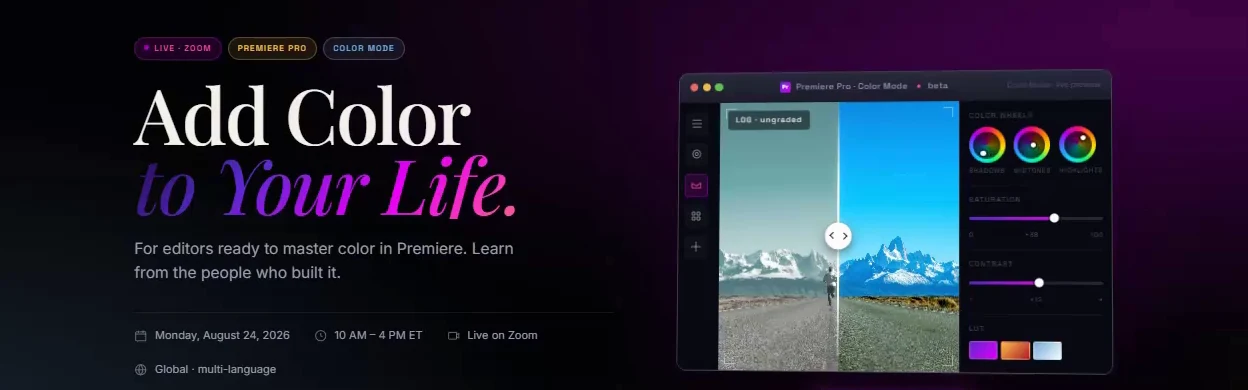
The concept site hero reading "Add Color to Your Life", beside a Premiere Pro Color Mode panel showing a draggable split between ungraded log footage and a graded version, with three-way color wheels and saturation and contrast sliders.

Creative direction and front-end engineering Independent concept

A conference experience you can step inside.

I conceived, designed, and built a three-language conference concept and its companion browser-based color-grading playground. The page opens on the product itself: drag a handle across Argentine footage and watch an ungraded frame become a finished shot. The companion tools run the same kind of grade live in the browser, on the visitor’s own hardware.

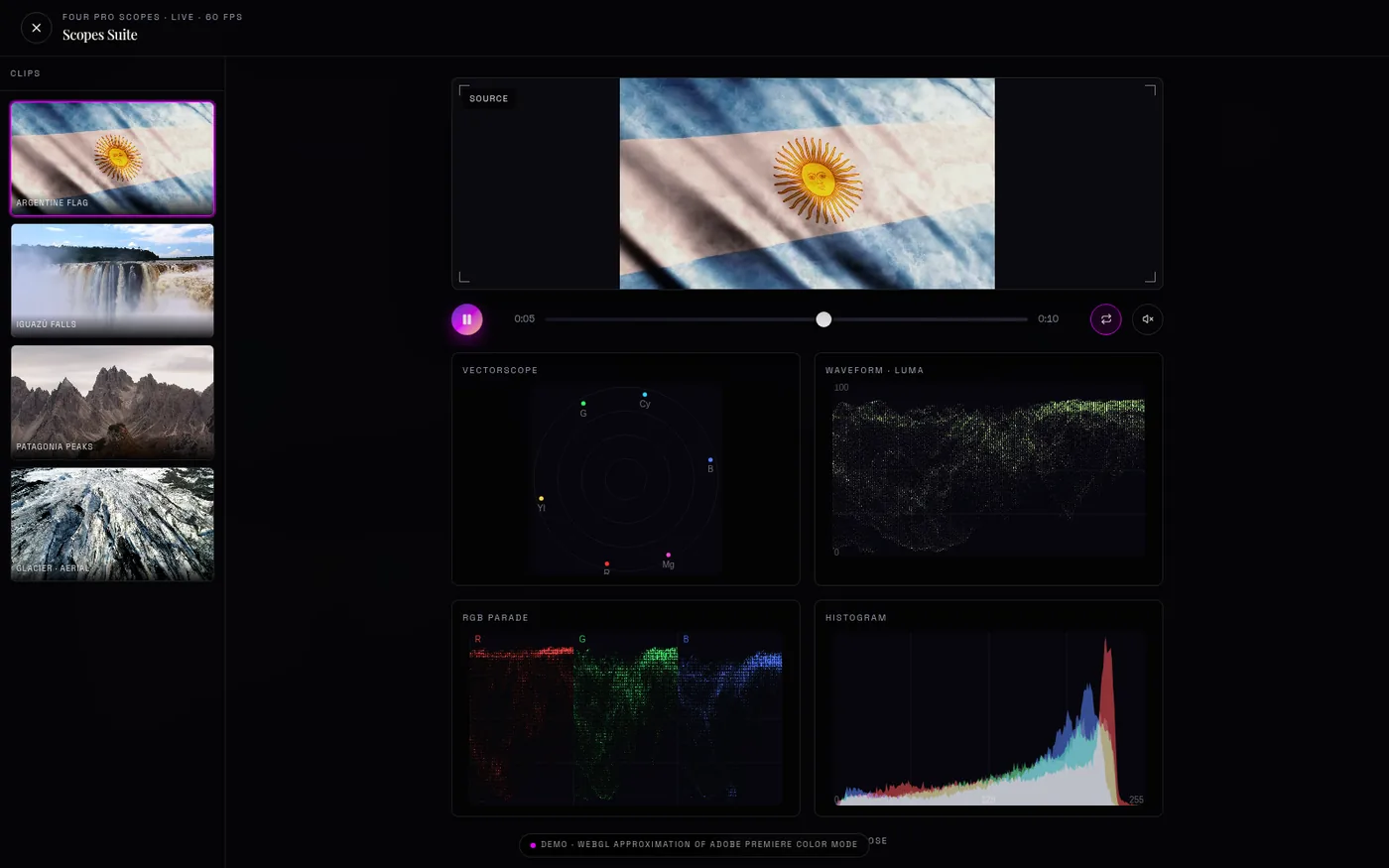
The Scopes Suite tool running against Argentine flag footage, with a vectorscope, luma waveform, RGB parade and histogram updating together, and a footer chip reading "demo, WebGL approximation of Adobe Premiere Color Mode".
Watch walkthrough3 min 29 sec · 9.6 MB

Narrated by me. Captions are on by default, and the full transcript is below.

Read the transcript

0:00Nobody commissioned this project. I originated the concept, creative direction, visual language, interactive experience, and technical architecture.

0:08Then personally built both applications as a speculative pitch for an FMC and Adobe Premiere Pro Color Mode conference.

0:14The event itself would teach the product. I designed the public experience to begin with the product, not a description of it.

0:22Visitors drag a live log to graded comparison across Argentine footage. I built the application by hand in WordPress without a page builder with mouse, touch, stylus, keyboard, and reduced motion support.

0:3313 coordinated sections carry the visitor from product demonstration through schedule, speakers, visual examples, pricing, contact, and registration.

0:46I designed the speaker cards to animate until the visitor takes control and dates and times adapt to locale. The names shown in this portfolio version are intentionally synthetic.

0:56I designed the experience around the product and its Argentine setting. The visual system, cinematic pacing, interactions, and cultural treatment were my own.

1:06A custom locale system governs 951 translations across Rio Platin Spanish, English, and Japanese. The palette uses Belgrano Celeste and Sol de Mayo.

1:16The conversion path is part of the same product design, tiered registration, inquiry rooting, group and sponsor interest, and a dedicated transaction hand-off.

1:25All contact details in this portfolio version have been replaced with demonstration data. The conference site is only the front door.

1:34I architected the tools as a second application using Next.js and TypeScript on another server. Purpose-built rooting preserves language across both systems without a shared database, API, or session.

1:45This is not an animation pretending to perform color grading. The browser compiles real grading operations into WebGL2 shaders and applies them to video and stills in real time.

1:57Exposure, lift, gamma, gain, contrast, white balance, saturation, and vibrance follow a professional processing order.

2:05Luminance uses exact Rec. 709 coefficients. Every interaction and control was conceived and built by me. That includes three-way color wheels, a curve editor, dual handle HSL ranges, parameter sliders, a live histogram, waveform, RGB parade, vector scope, and 3D LUT cube viewer.

2:33The tools operate on 16 curated Argentine media assets and seven original grade presets. The three tonal masks sum to one at every luminance value so lifting shadows does not quietly brighten the entire image.

2:49A complete grade, represented by 24 floating point values, can be serialized into a shareable URL. If that URL is malformed, the application falls back safely instead of breaking.

2:59Because this was a pitch, not an authorized Adobe property. Both sites are blocked from search indexing and permanently labeled as demonstrations.

3:10The proof remains functional without misrepresenting the relationship. The result is 12,089 lines across two stacks.

3:18I originated the idea, directed every creative decision, designed the complete experience, architected both systems, and personally built the project down to the GPU color mathematics.

How both sites were built

Conference experience

  • Spanish, English and Japanese experiences, with language-aware navigation between the two sites
  • The page opens on the product itself: a draggable log-to-graded comparison over Argentine footage
  • Custom WordPress theme built by hand, with no page builder.
  • Mouse, touch, stylus, keyboard and reduced-motion support on the comparison control.
  • Thirteen coordinated sections carry the visitor from the product demonstration through schedule, speakers, visual examples, pricing and contact.
  • A custom locale system governs 951 translations across Rioplatense Spanish, English and Japanese, with dates and times adapting to locale.
  • Six graded treatments of the same Argentine footage carry the visual argument for the release.
Screenshot
Concept site, frame from the supplied recording. A frame from the narrated recording supplied by James, cropped below the navigation bar. The live host sits behind Cloudflare bot protection that refused this environment, and it was not evaded.
About this destination
A speculative pitch, not a live event. Its pricing and registration controls are part of the design and are not a real purchase. It also sits behind bot protection, so an automated client may be challenged where an ordinary browser is not.

Browser grading tools

  • Six tools: video and photo grading, RGB and luma curves, HSL qualification, a 3D LUT cube and a four-instrument scopes suite
  • Sixteen curated Argentine media assets and seven original grade presets ship with it
  • GPU-based grading with custom controls and scopes, built on three separate WebGL programs.
  • Exposure, lift, gamma, gain, contrast, white balance, saturation and vibrance are applied in a fixed processing order.
  • The three tonal masks sum to one at every luminance value, so lifting shadows does not quietly brighten the whole image.
  • A complete grade, 24 floating point values, serializes into a shareable URL. A malformed URL falls back safely rather than breaking.
  • Static export, so there is no upload path and no backend to secure. Routing preserves language across both sites without a shared database, API or session.
Screenshot
Concept site, frame from the supplied recording. Capture supplied by James, taken before this host was placed off limits. It received no request during this work, and its link was built and checked by URL parsing only.
About this destination
A demonstration of what a browser can do with color. It is not Adobe software and not a replacement for Premiere Pro. Both concept sites are blocked from search indexing and permanently labeled as demonstrations.

Business ownership and platform engineering

The systems behind a medical consulting business.

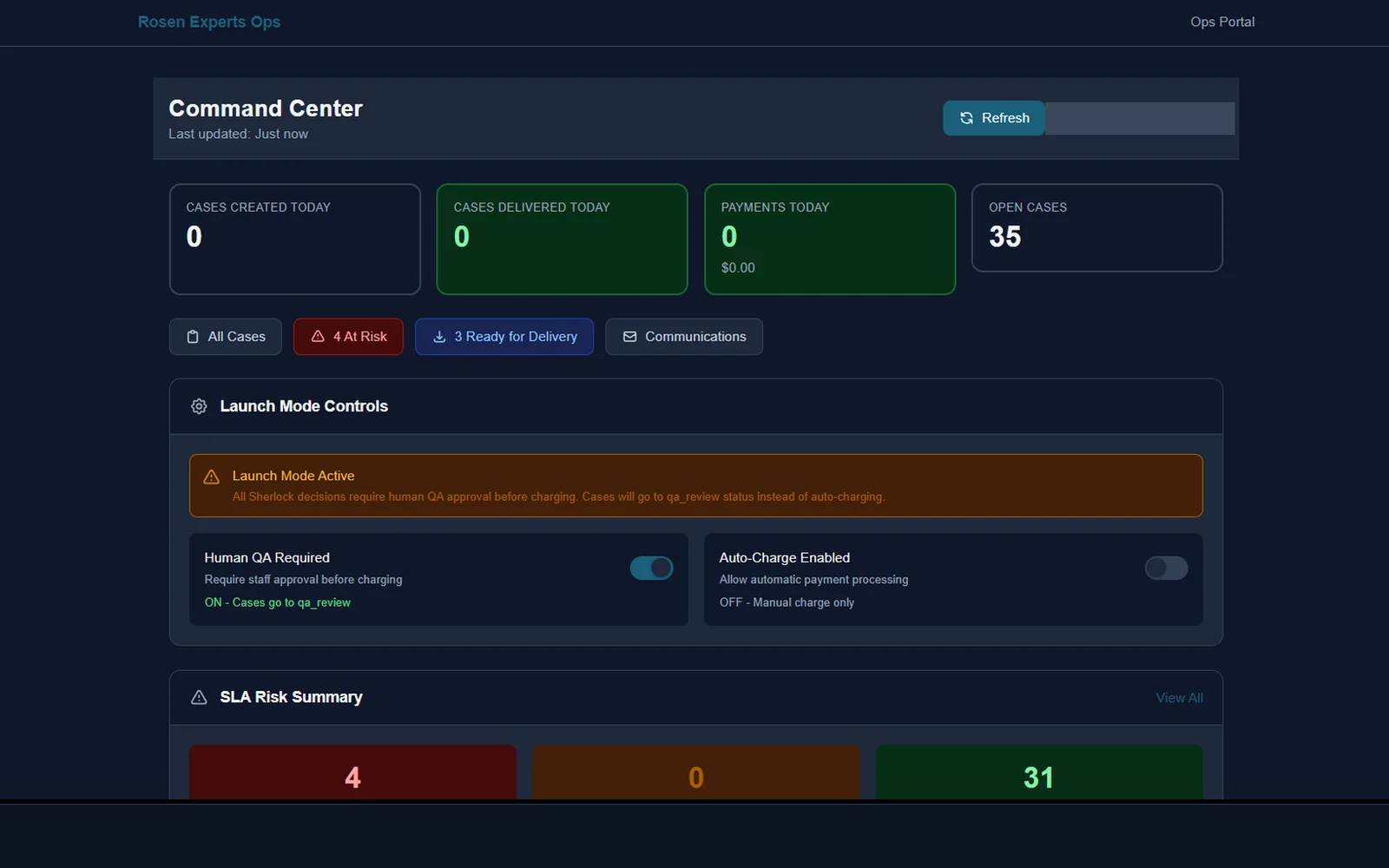
The Rosen operations command center: counters for cases created, delivered, payments and open cases, a launch mode panel with human approval switched on and auto-charge switched off, and a service-level risk summary.

Private operations platform. Preview shown with identifying information removed.

I own Rosen Medical Consulting and built the connected experiences supporting its public presence, client intake, and internal operations. Records arrive through a secure channel rather than by email, and no automated decision reaches a client’s card until a person has approved it. Clients, physicians and reviewers all work from one case record.

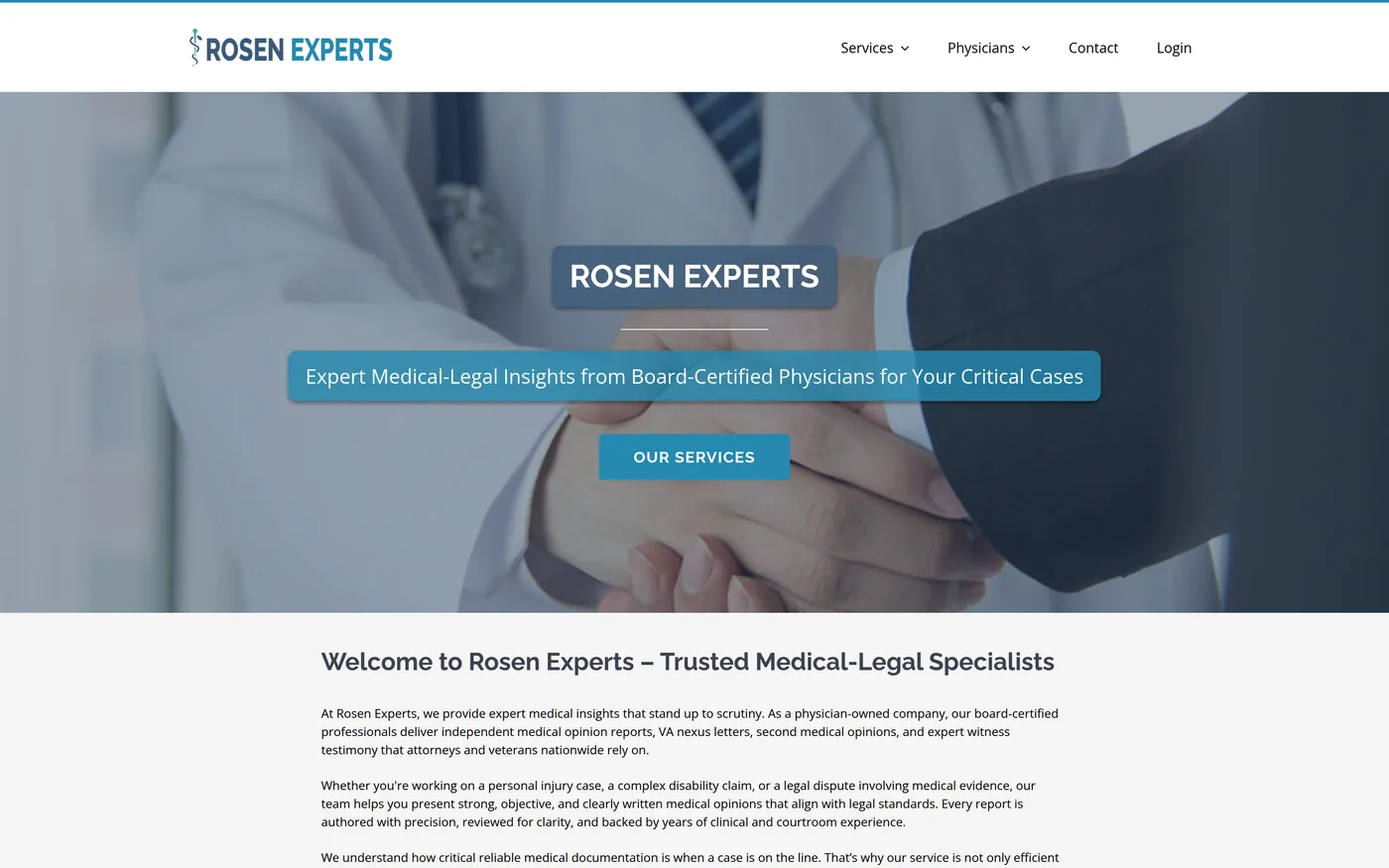
Rosen Experts public homepage, headed "Expert Medical-Legal Insights from Board-Certified Physicians for Your Critical Cases", with a services call to action.
Public websiterosenexperts.com
Visit the website (opens in a new tab)
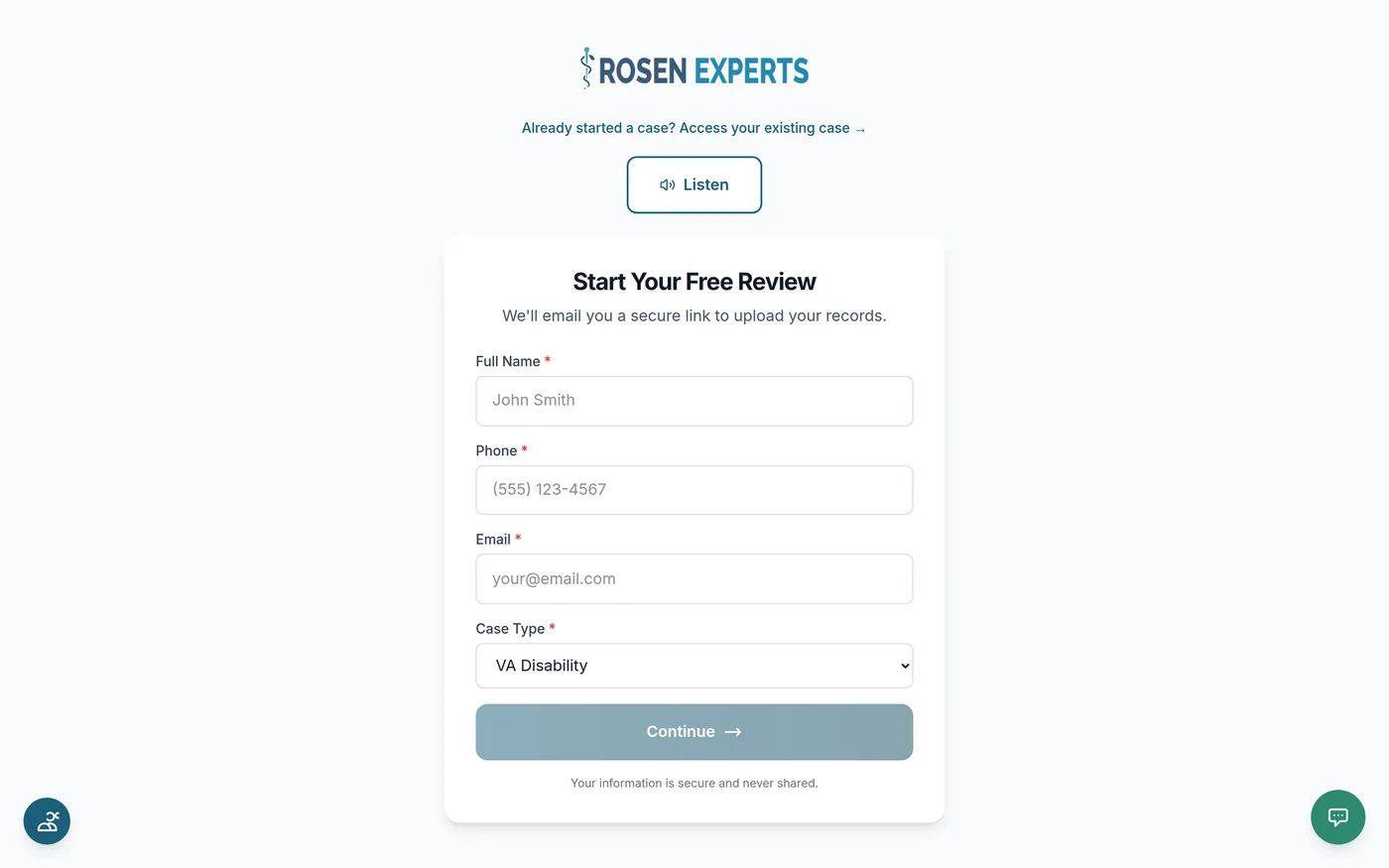
The Rosen Experts free review intake form, empty, showing name, phone, email and case type fields with a listen-aloud control above it.
Client intake and portalcase.rosenexperts.com
Visit the intake (opens in a new tab)
How the platform is built

Operations platform

  • Launch mode forces every automated decision through staff approval before a client is charged
  • Service-level risk is summarized on the same screen as the work, so a breach is visible before a client notices it
  • The command center shows cases created, delivered, payments taken and open case load across the practice.
  • Auto-charge is off by default. The screenshot shows it off, which is its real state.
  • Separate physician and quality-assurance surfaces sit behind the same case record and audit trail.
Screenshot
Production system, identifying information removed. Production system. Aggregate operating counts only. The staff account identifier is covered by a solid irreversible block, re-checked at full size before this image was enlarged. No patient, client or case record appears, and no staff URL is published.

Public website

  • Conversion pages built to qualify a case before any payment is taken
  • A creator video library running a seven-stage production pipeline over a demand-ranked script catalog
  • Public marketing site carrying service, FAQ and breadcrumb structured data.
  • The video library holds a live catalog of English scripts, ranked by demand and filtered on four axes.
  • WordPress on SiteGround, separate from the two application surfaces, which are a Next.js monorepo.
Screenshot
Public page, captured live. Captured live from the public site on 2026-09-10. No client or case data is present.
Client intake and portal

  • Structured intake that issues a secure upload link rather than asking for records by email
  • Client case portal with two-way secure messaging, progress tracking and document exchange
  • The upload path accepts password-protected medical exports and unlocks them inside the pipeline.
  • Intake carries a read-aloud control and an accessibility panel.
  • Protected health information never travels by email, which is the point of the whole design.
Screenshot
Live form, no data entered. Captured live from the public intake on 2026-09-10 with nothing entered and nothing submitted. The visible values are the form’s own placeholders.

Product ownership and bilingual delivery

A business launch service, built from the ground up.

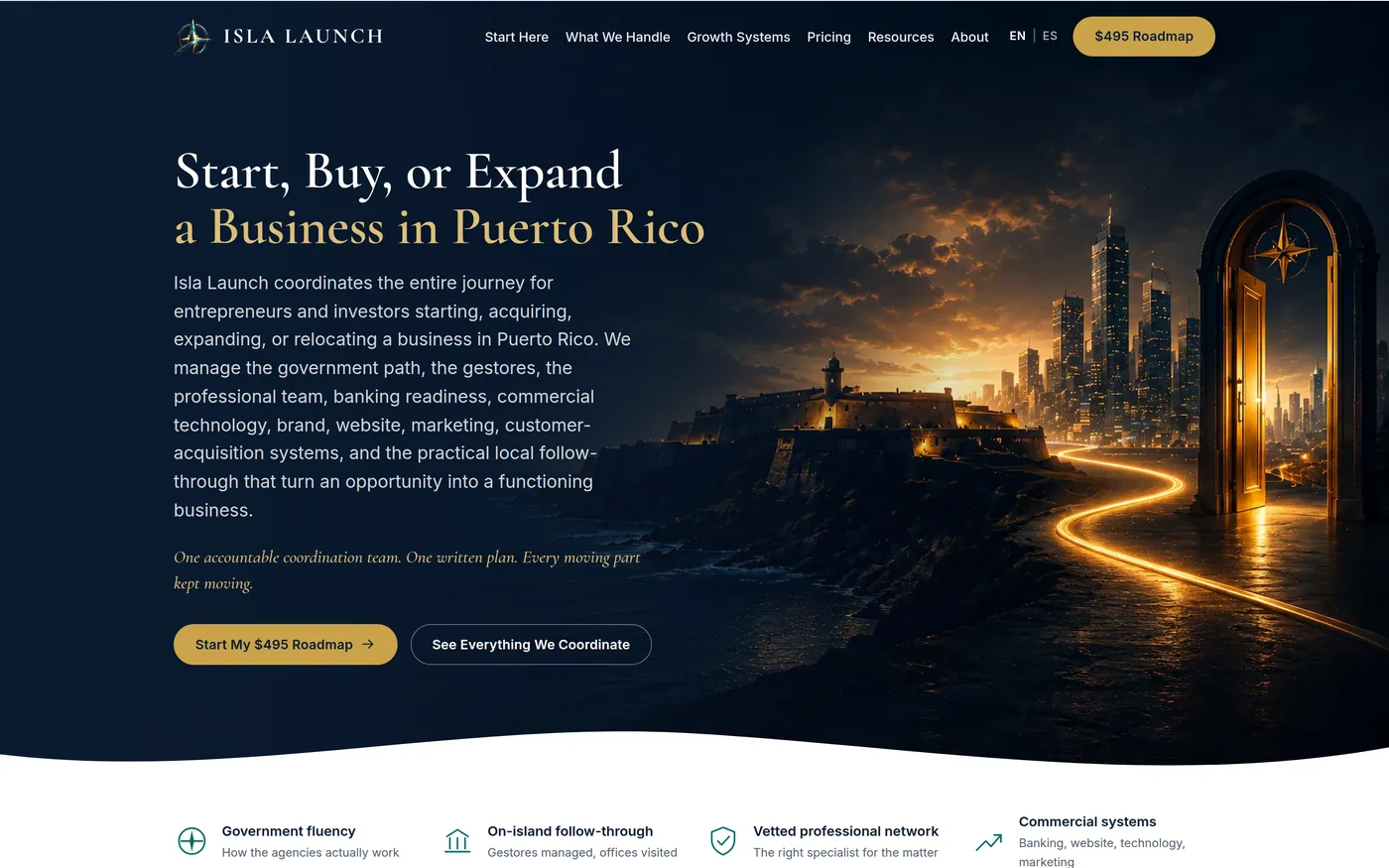
Isla Launch homepage, headed "Start, Buy, or Expand a Business in Puerto Rico", with a language switcher and a roadmap call to action over a night view of San Juan.

I co-founded Isla Launch and built its bilingual website, guided intake, payment handoff, and supporting operational workflows. A founder can start in English or Spanish, leave the intake and come back to it later, and the price published on the site is the price they are charged. Behind it, every inquiry keeps a frozen original and a change history.

Visit Isla Launch (opens in a new tab)
How the service is built
  • Full bilingual product in English and Puerto Rican Spanish, English by default
  • Structured intake a founder can leave and resume, with payment handoff behind it
  • The administrative side keeps frozen originals and a change history on every inquiry.
  • Incomplete intakes carry a takeover workflow, and documents carry versions and an audit trail.
  • Published price is the charged price. No tax is added at checkout.
  • What is genuinely absent is the client-facing portal. The administration behind it is extensive.
Screenshot
Public page, captured live. Captured live from the public site on 2026-09-10.
Read the full case file below
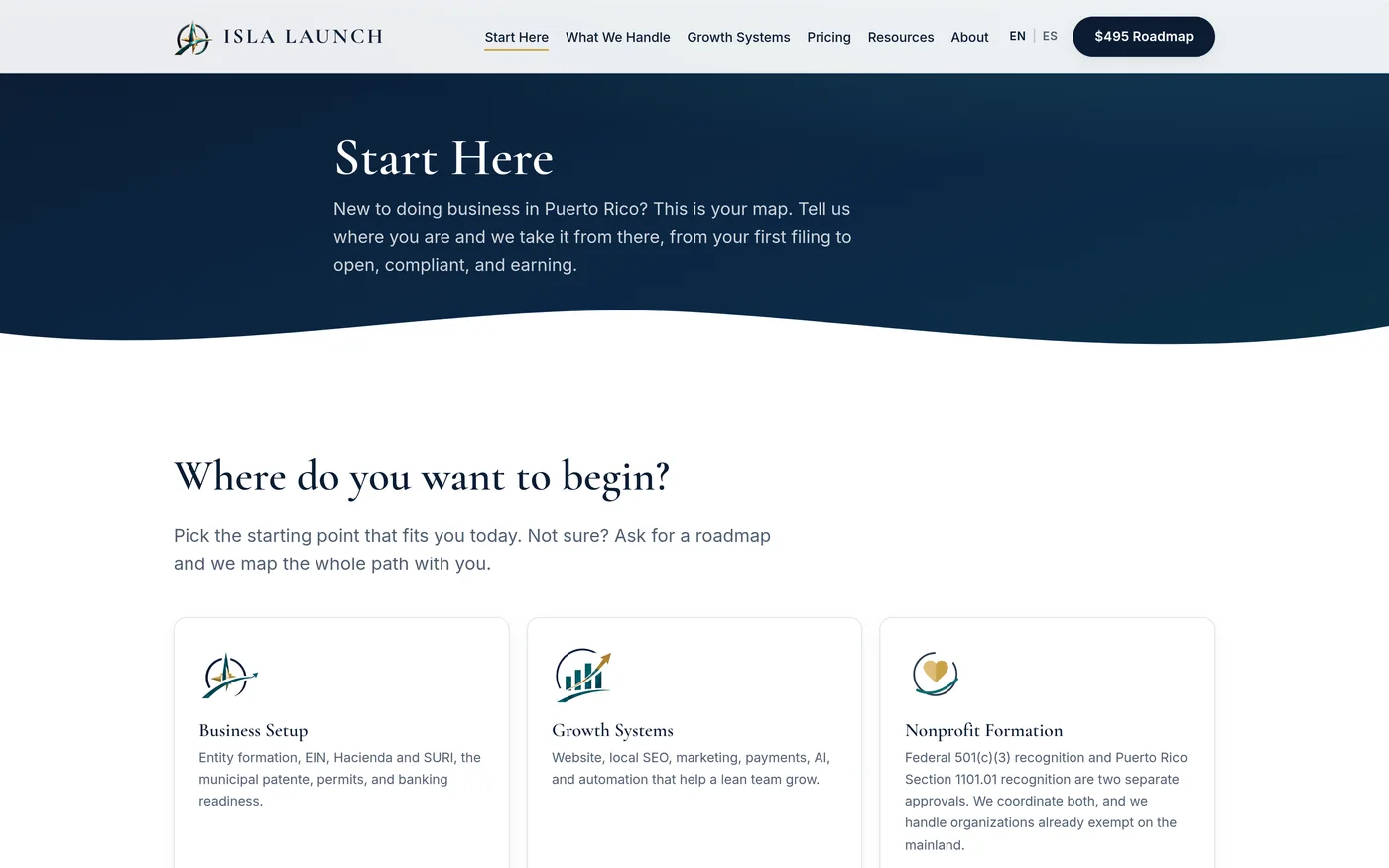
The Isla Launch "Start Here" page, headed "Where do you want to begin?", offering business setup, growth systems and nonprofit formation as starting points.
The guided intake, where a founder picks a starting point

Engineering ENGINEERING BEHIND THE WORK

Production scale :: PRODUCTION SCALE · VERIFIEDCOUNTED FROM SOURCE, NOT FROM MEMORY
40
SHARED MODULES IN PRODUCTION
Loaded by the running router, not just present
63
MOUNTED API PATHS
HMAC by default. Public exceptions are explicit.
5
PREFLIGHT REGRESSION GATES
One bad signing change locks out every caller

Counted on the running system on 2026-09-08, read-only. Figures that could not be counted from source are not shown.

Shared integration platformINTERNAL PRODUCTION

One secure integration layer, many products, no shared-secret sprawl.

Every new product wanted the same things: billing, CRM, email, storage, document processing. Rebuilding those integrations per product means duplicated credentials in multiple codebases, and every copy is another place a master secret can leak.

OPEN CASE FILE
CTO DECISION
Convert repeated integration work into a governed internal platform. Applications and agents receive a contract instead of a credential, so a product can use a sensitive capability without ever holding the secret that reaches it. No browser and no AI agent holds a master secret.
WHAT I OWNED
  • The service boundary, and which capabilities cross it
  • Authentication model for service-to-service traffic
  • Tenant isolation and audit requirements
  • Change discipline on a boundary many products depend on
WHAT I PERSONALLY IMPLEMENTED
  • HMAC signing and verification with a five minute replay window
  • The shared module layer and the router that mounts it
  • Tenant-scoped request context and audit logging
  • A signing path that lets an agent sign a request without reading the secret
  • Five preflight regression scripts that gate any change to signing
SYSTEM
  • 40 shared modules loaded by one Express router, wrapping cloud, payment, communications and clinical providers
  • 63 mounted API paths, signed by default, with public exceptions enumerated in a written route matrix rather than left implicit
  • A registry pattern that lets a new provider be added without editing the core
  • Tenant identity carried explicitly on every request, with server-side token refresh
RISK CONTROLS
  • Secrets never reach browsers or agent hosts
  • Signature verification at the boundary rather than per route
  • Public routes are an explicit allowlist, not an omission
  • Five preflight scripts must pass before any signing change ships, because one bad signing change breaks authentication for every caller at once
RESULT
A new product integrates against a reviewed contract instead of copying credentials. Integration risk is concentrated in one auditable, versioned place, and a provider can be added without touching the code every other product depends on.
EVIDENCE
  • 40 shared modules loaded by the running router and 63 mounted API paths, counted from source on 2026-09-08
  • Written security route matrix covering signed and public routes
  • Five executable preflight regression scripts
STACK
  • Node
  • Express
  • HMAC
  • OAuth
  • PostgreSQL
  • AWS
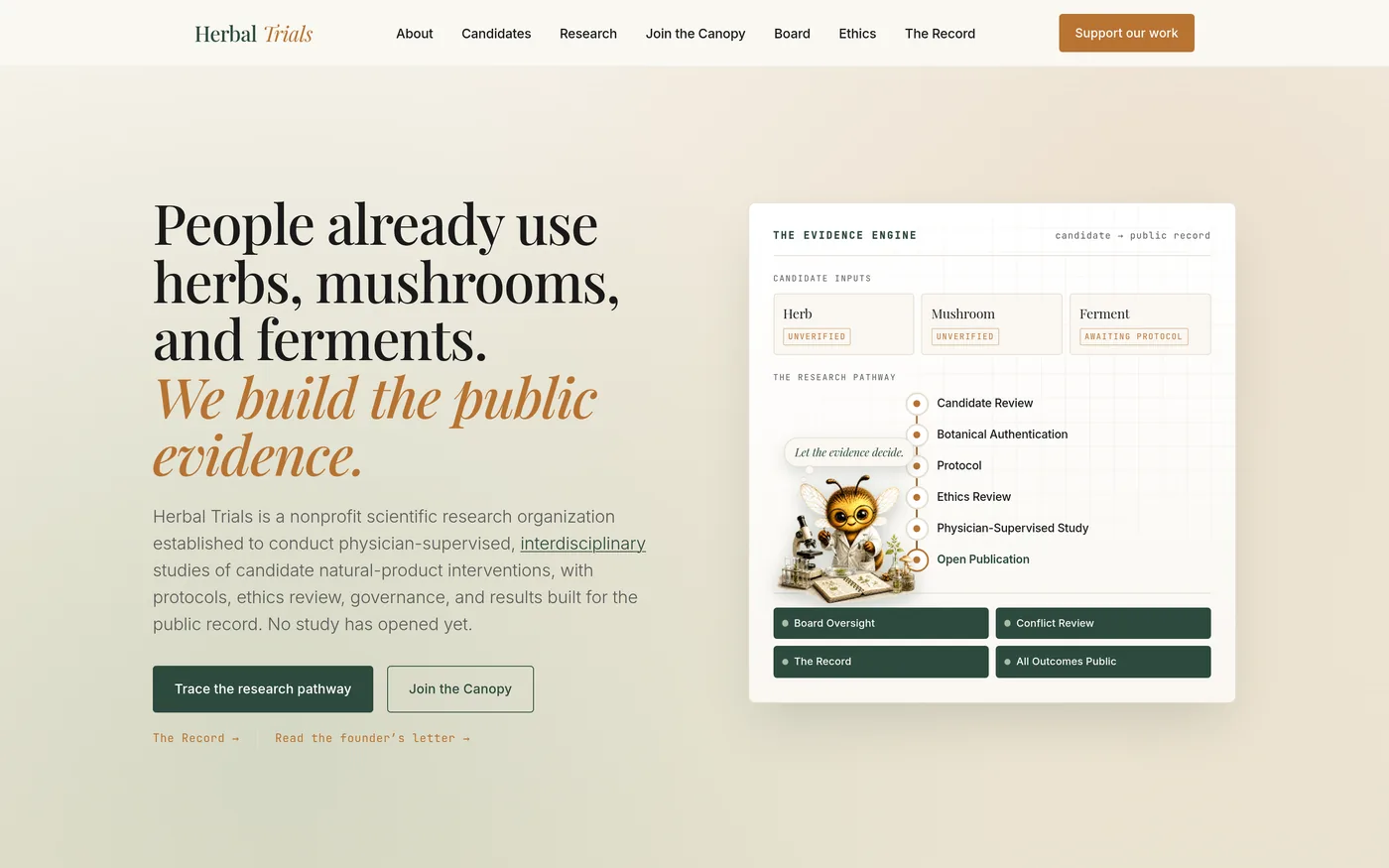
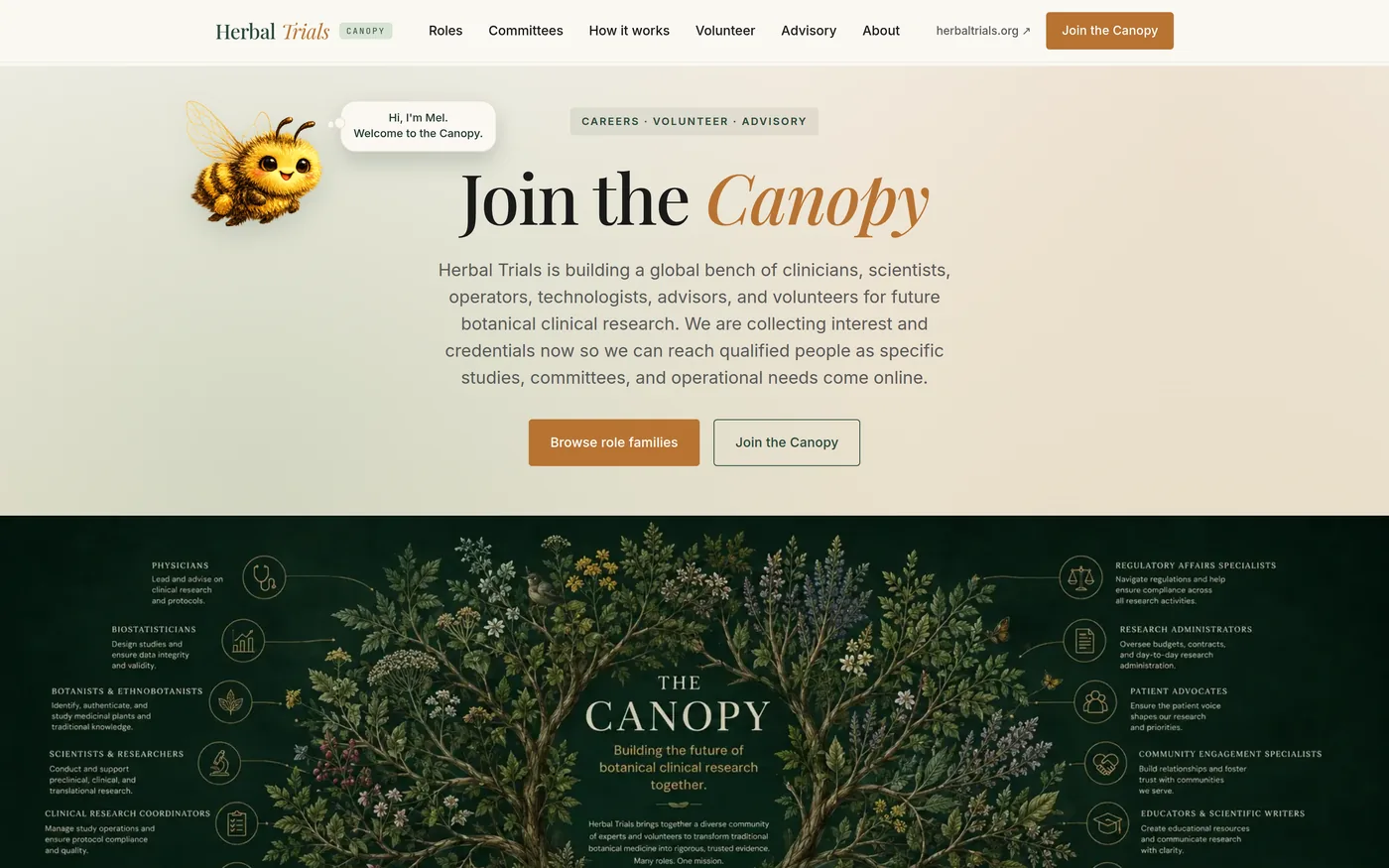
Herbal TrialsLIVE PUBLIC

Building the operating foundation for a new research nonprofit.

A nonprofit that intends to run physician-supervised studies of herbs, mushrooms, fermented foods, and other natural products has to be credible before it has any results. Governance, recruitment, and public transparency all have to exist on day zero, when there is nothing yet to point at.

OPEN CASE FILE
CTO DECISION
Build the organizational and technical foundation first, and make the transparency commitment structural rather than promotional. Publish the policy that every result will be published, including negative and inconclusive ones, and build the governance system that makes that commitment auditable.
WHAT I OWNED
  • Founding the organization and its technology direction
  • Governance model and the systems that record it
  • Public presentation and recruitment strategy
  • Boundary on where AI is and is not permitted
WHAT I PERSONALLY IMPLEMENTED
  • Public website and content platform
  • Board governance portal: minutes, documents, amendment proposals, signature collection, voting workflows
  • Canopy role hub organizing interdisciplinary volunteer roles
  • Recruitment platform and intake
SYSTEM
  • Public nonprofit site
  • Multi-tenant governance portal with an audit trail
  • Canopy: clinical, botanical, study design, data, regulatory and ethics, community, technology, operations, and bench roles
RISK CONTROLS
  • No generative AI inside the governance portal, by design
  • Signature capture and recorded votes
  • Publish-every-result commitment stated as policy
RESULT
The nonprofit, its public site, its governance foundation, the recruitment platform, and the Canopy role hub exist and operate. The publish-every-result policy is a commitment about future results.
CURRENT STAGE

No study has opened, so no participants are enrolled and no results exist.

EVIDENCE
  • 501(c)(3) status granted, effective 2025-12-31
  • Public site and governance portal both responding
VIEW LIVE ↗
STACK
  • WordPress
  • Next.js
  • PostgreSQL
  • Governance portal
  • Multi-tenant
Isla LaunchLIVE PUBLIC

Turning a bureaucratic process into a guided operating system.

Launching a business in Puerto Rico means navigating a sequence of agencies, forms, and requirements that most founders cannot hold in their heads, in two languages, with money changing hands partway through.

OPEN CASE FILE
CTO DECISION
Treat the bureaucracy as a product problem. Convert an unstructured advisory process into a guided, bilingual journey with structured data capture, so the same questions are asked the same way every time and the answers are usable downstream.
WHAT I OWNED
  • Product model for the service itself
  • Bilingual customer journey and language strategy
  • Structured intake design and data capture
  • Payment handoff and privacy disclosures
  • What the service will and will not represent itself as
WHAT I PERSONALLY IMPLEMENTED
  • Bilingual public experience with an English default and Spanish path
  • Structured, resumable intake
  • Payment handoff
  • Lead handling and operational workflow
SYSTEM
  • Public bilingual site
  • Structured intake with resume capability
  • Payment handoff and lead routing
RISK CONTROLS
  • Published price is the charged price
  • Privacy disclosures presented at the point of capture
  • Clear boundary on the nature of the service and what it does not provide
RESULT
The live public experience, the bilingual journey, structured intake, payment handoff, and lead handling operate.
CURRENT BOUNDARY

The client-facing portal is not built.

EVIDENCE
  • Live public site and working intake
VIEW LIVE ↗
STACK
  • WordPress
  • Bilingual ES/EN
  • Structured intake
  • Payments
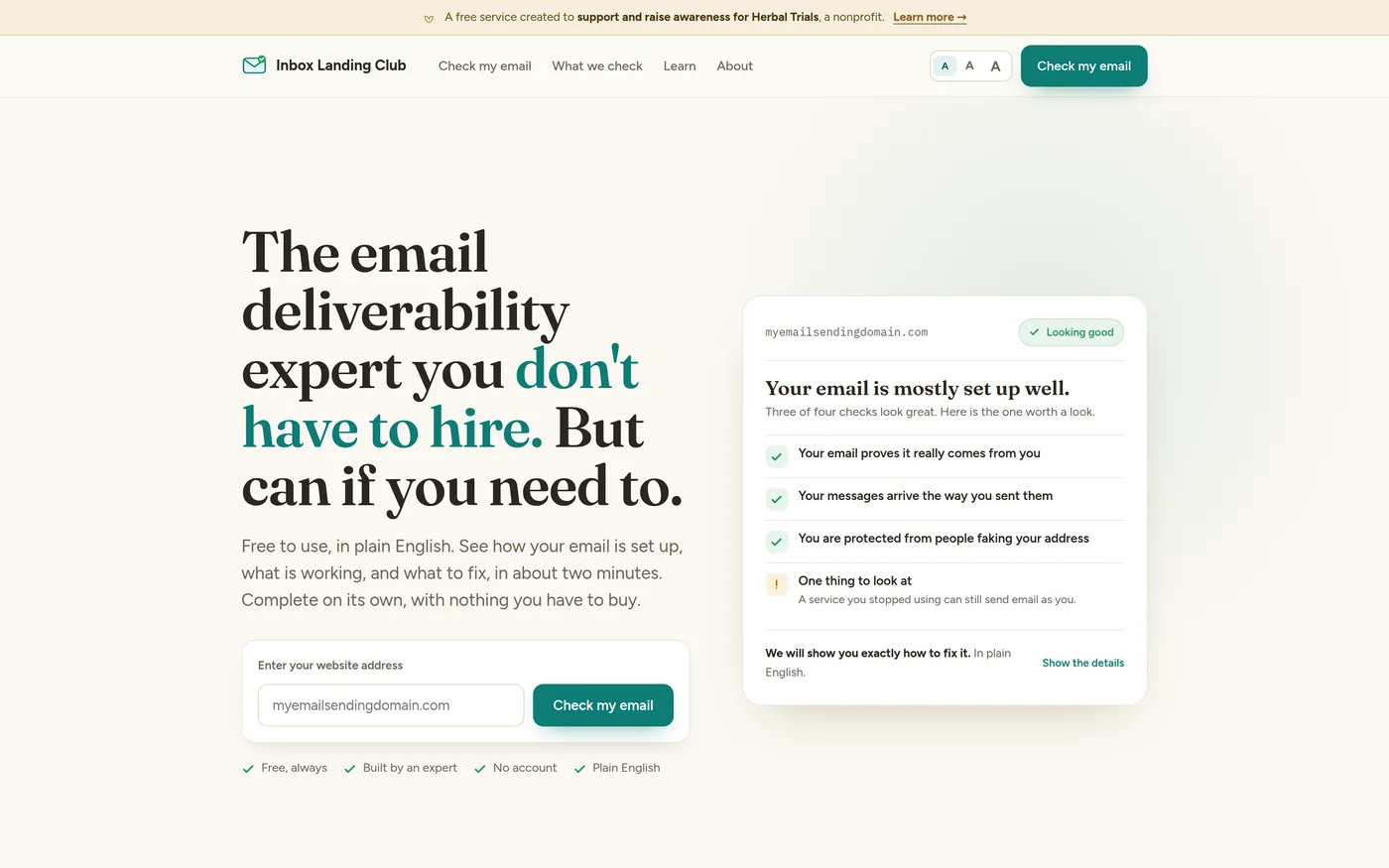
Inbox Landing ClubLIVE PUBLIC

Publishing the fix, not only the finding.

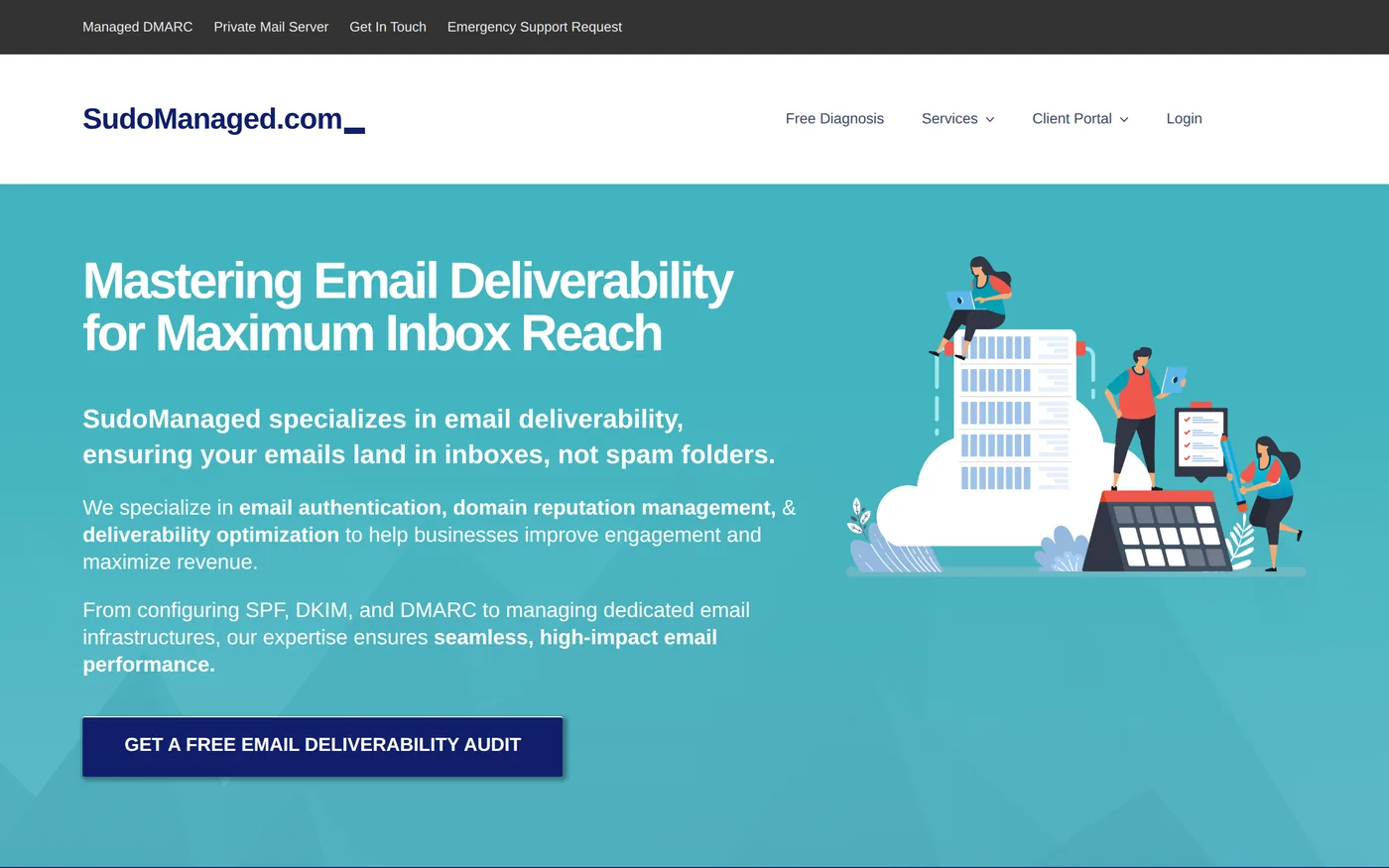
Email deliverability tooling diagnoses the problem and then charges for the cure, which leaves the operator holding a verdict they cannot act on.

OPEN CASE FILE
CTO DECISION
Publish the remediation alongside the finding, and make the diagnosis deterministic enough to stand behind. A free scanner that guesses is worse than no scanner, so the verdict model was designed before the checks: a check that cannot establish an answer reports that it could not, rather than producing a confident one.
WHAT I OWNED
  • The decision to publish the remediation, not only the finding
  • The verdict model, and the rule that an undetermined check may not present a verdict
  • Severity doctrine, and the separation of severity from confidence
  • What the scanner is allowed to assert, and on what basis
WHAT I PERSONALLY IMPLEMENTED
  • The public scanner and the WordPress adapter that runs it
  • A DNS resolver across UDP, TCP and DoH with raw packet parsing, confirming answers against the zone’s own nameservers rather than trusting one resolver
  • DMARC record parsing and the organizational domain tree walk
  • The finding model that carries verdict, severity and confidence as separate axes
SYSTEM
  • Free public scanner requiring no account
  • Multi-transport DNS resolution over UDP, TCP and DoH, with the wire format parsed directly
  • Twelve record types queried, including the DNSSEC and certificate-association records most tools skip
  • Results render in the page and never get a URL of their own, so no report is indexable
RISK CONTROLS
  • Only a check that establishes an answer may produce a verdict. One that cannot returns indeterminate, which is a first-class result rather than a silent pass
  • Confidence is recorded separately from the verdict, so a probable answer is never presented as a certain one
  • Severity describes exposure, not fix difficulty
  • Answers are confirmed against the zone’s own nameservers, because a single resolver can be stale or lying
  • A frozen reference harness gates any change to the engine, so behavior that was guaranteed cannot quietly regress
RESULT
The scanner is live, free, and publishes the remediation with the finding. Its verdicts are constrained by design: the engine can return that a check was indeterminate, and does, rather than converting an unresolved lookup into a confident answer the operator would then act on.
EVIDENCE
  • Live public scanner, no account required
  • Three DNS transports implemented with direct wire-format parsing
  • Verdict, severity and confidence modeled as separate axes in source
VIEW LIVE ↗
STACK
  • PHP
  • WordPress
  • DNS over UDP / TCP / DoH
  • Deterministic verdict model
Shared software architectureINTERNAL PRODUCTION

A software estate, not a pile of plugins.

Running many small organizations on separate stacks multiplies cost and risk in equal measure. Every duplicated pattern is another thing to patch, another credential to rotate, and another way for one tenant to become another tenant’s problem.

OPEN CASE FILE
CTO DECISION
Build one house architecture and make every product conform to it, rather than solving the same problems once per site. Share the code, isolate the tenants, and keep sending reputation separated so one sender cannot damage another. The point is not that many sites are maintained. It is that a small organization can control security, publishing, analytics, communications and integrations across an estate without hiring a team to do it.
WHAT I OWNED
  • The house architecture every in-house product conforms to
  • Tenant isolation model, and where the boundaries sit
  • Sending reputation separation across the estate
  • What becomes a shared capability and what stays local to one site
WHAT I PERSONALLY IMPLEMENTED
  • Encryption of sensitive values at rest, using AES-256-GCM
  • WP-CLI commands as a first-class interface, so anything clickable is also scriptable
  • Presentation kept out of the products, so none of them locks a site to a theme
  • Per-tenant sending separation
SYSTEM
  • In-house products sharing one architecture rather than one codebase per site
  • Sensitive values encrypted at rest with AES-256-GCM
  • WP-CLI commands alongside every administrative screen
  • Tenant and sending-reputation isolation across the estate
RISK CONTROLS
  • Credentials encrypted at rest, never stored in plain configuration
  • Every administrative action reachable without a browser, so recovery does not depend on a working admin screen
  • One tenant’s sending reputation cannot damage another’s
  • Products do not depend on a theme, so a presentation change cannot break an operation
RESULT
A portfolio of organizations runs on shared engineering with isolated tenancy, operated and controlled by one technical owner. Adding an organization is a configuration exercise rather than a rebuild.
EVIDENCE
  • AES-256-GCM encryption verified in the source of five in-house products
  • WP-CLI command registration verified in the source of seven
  • Estate configuration reviewed directly, tenant by tenant
STACK
  • PHP
  • WordPress
  • WP-CLI
  • AES-256-GCM
  • Multi-tenant

Most of my commercial work is under mutual NDA and cannot be shown. The case files above are the ones I can disclose in full.

Systems lab :: INTERACTIVE IMPLEMENTATION PROOF

You should be able to inspect how I think, not just read what I claim.

Three working demonstrations. Each one runs the real interaction model against synthetic data, and each one says so on its face. No customer data is transmitted, and nothing here is connected to a production system.

Operating evidence :: MEASURED, NOT DECORATIVEREAD FROM THE RUNNING SYSTEM
RELEASE
48955bb91
Git commit this bundle was built from
BUILT
2026-09-22 20:06:34Z
When this bundle was compiled, UTC
INTAKE
checking...
Live request to the inquiry service, with its process uptime
ROUND TRIP
not measured
Your browser to this origin and back, measured on this page load

Site-level uptime is not shown, because no external monitor is measuring it yet. A figure with nothing behind it is the kind of claim this page exists to avoid.

[CFO]:: DEMO 01 · EXECUTIVE OPERATING VIEW · SYNTHETIC DATA

A decision surface built around how the company actually operates.

Dashboards fail when they reproduce a database instead of the decisions an executive must make. This demonstration connects revenue, burn, runway, margin, retention, anomalies, and transactions in one operating view. The data is synthetic. The product and interaction model are functional.

  • Switch between portfolio companies and watch every surface re-baseline
  • Change the time window across revenue, burn, runway and margin
  • Read a cohort retention heatmap alongside anomalies and recent transactions
  • Reset the demonstration to its opening state at any point
LOADS AUTOMATICALLY AS YOU REACH IT
[RTR]:: DEMO 02 · INTEGRATION CONTROL · SIMULATED PAYLOAD

Data moves once. Every boundary leaves evidence.

This simulation traces a representative CRM webhook through signature verification, mapping, idempotency, parallel delivery, and an audit record. It demonstrates the production pattern without transmitting real customer data.

  • A webhook arrives and its signature is verified at the edge
  • The payload is mapped between schemas and given an idempotency key
  • It is delivered to three systems in parallel, with an audit row written
  • The trace settles on a completed state, and can be re-run or reset
LOADS AUTOMATICALLY AS YOU REACH IT
[DCD]:: DEMO 03 · HUMAN-REVIEWED DECISION SUPPORT · SYNTHETIC CASE

High-stakes AI must show its evidence, limits, and handoff.

This synthetic demonstration shows a document workflow that extracts evidence, applies named rules, redacts sensitive fields, records an audit trail, and prepares a recommendation for human review. It is decision support, not autonomous medical or legal judgment.

  • Evidence is extracted from a synthetic case file and cited back to its source
  • Named rules are applied and their matches shown, not just their conclusions
  • Sensitive fields are redacted while clinically relevant data is preserved
  • The output is a recommendation that requires human approval, never a decision
LOADS AUTOMATICALLY AS YOU REACH IT

[MOD] :: HOW I ENTER THE COMPANY

A clear mandate, real access, and responsibility that reaches production.

The title only matters if the decision rights and outcome are clear. Every engagement begins by defining what I own, what success means, who must be involved, and what the company needs to know in the next 30, 60, and 90 days.

  1. STEP 0

    A short fit check.

    20 minutes to determine whether the problem belongs at the CTO level, whether I am the right person for it, and whether the timing and access are real. This is not a free architecture session.

    DELIVERABLE

    Fit decision and next-step scope

  2. STEP 1

    Inspect the actual company.

    I review the business goals, people, code, infrastructure, vendors, data flows, security boundaries, commitments, and failure history. Assumptions become a fact base.

    DELIVERABLE

    Current-state brief and risk register

  3. STEP 2

    Make the decisions visible.

    I define the technology thesis, priorities, architecture, decision rights, delivery model, budget implications, and measurable outcomes for the next operating window.

    DELIVERABLE

    30/60/90 mandate and decision package

  4. STEP 3

    Move the company, not just the roadmap.

    I lead the internal team and vendors, establish cadence and standards, remove blockers, and personally implement the critical path when direct execution creates the most leverage.

    DELIVERABLE

    Working releases, decision log, and executive reporting

  5. STEP 4

    Leave the system stronger than the engagement.

    I establish monitoring, documentation, runbooks, ownership, hiring or handoff plans, and the operating discipline required for the company to keep moving.

    DELIVERABLE

    Operating system, runbooks, and succession path

Engagement forms ENGAGEMENT FORMS

[FCTO]PRIMARY

Fractional CTO

Ongoing part-time executive ownership for companies that need a CTO in the seat without a full-time hire. I own direction, delivery, risk, team and vendor alignment, and the technology decisions that reach the rest of the business.

[INTM]

Interim or turnaround CTO

A concentrated mandate during a leadership gap, failed build, migration, incident, fundraise, due-diligence process, or transition to a permanent technical executive.

[DIAG]

CTO diagnostic

A time-boxed, paid investigation for a consequential decision. The output is a technically defensible current-state assessment, risk register, recommendation, and execution sequence.

Focused advisory and implementation work is billed at $300 per hour. Fractional CTO mandates are scoped around responsibility, access, and reserved capacity.

[JTO] :: THE PERSON IN THE SEAT

James T. O'Mara

More than two decades turning business problems into systems that work.

James T. O'Mara
  • 20+ YEARS · TECHNOLOGY + BUSINESS
  • FOUNDER · CTO · IMPLEMENTER
  • TAMPA, FL · REMOTE WORLDWIDE
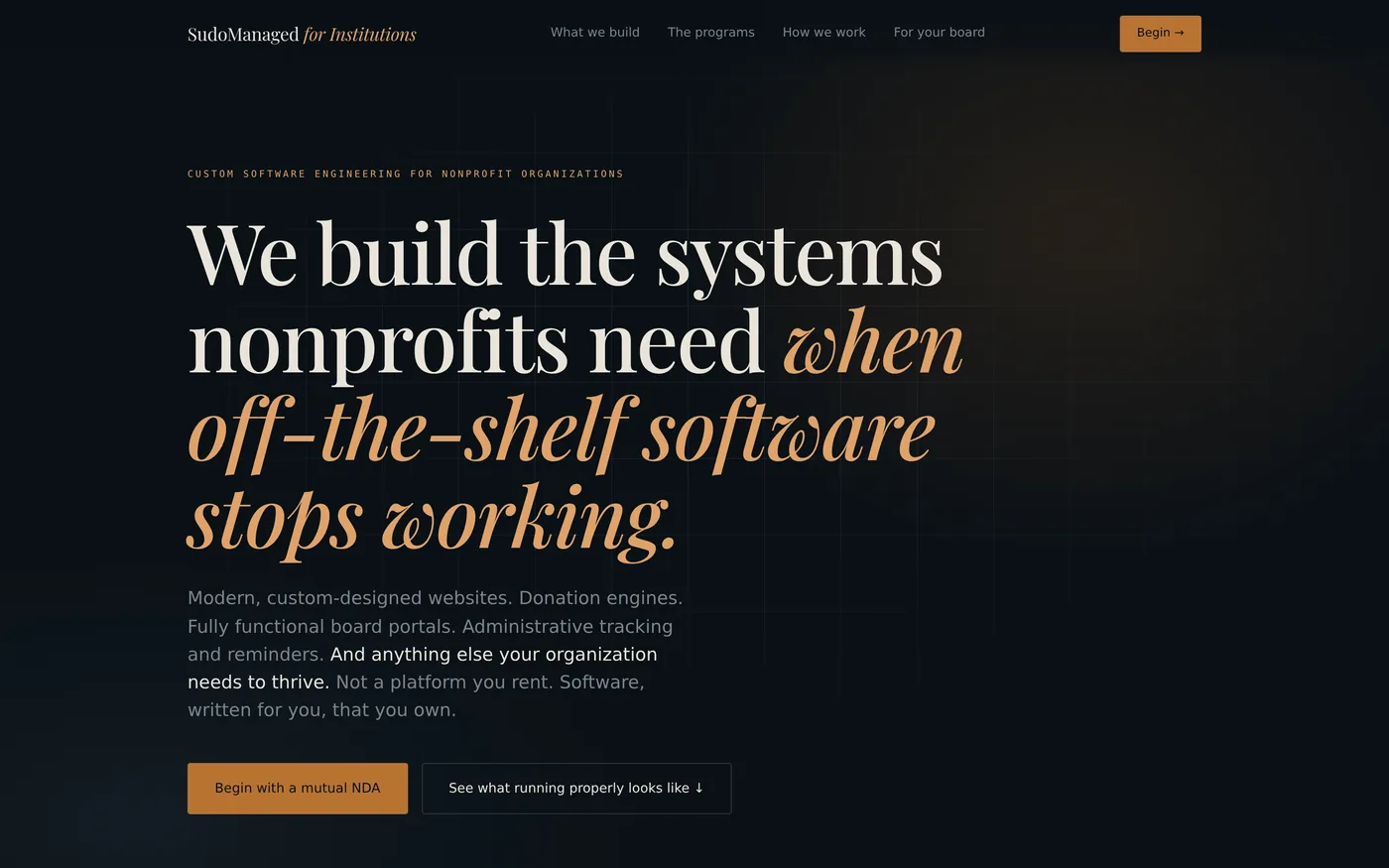
  • SUDOMANAGED · HERBAL TRIALS · ISLA LAUNCH

I am James T. O'Mara, founder of SudoManaged and Herbal Trials, co-founder of Isla Launch, and a hands-on technology executive. My work crosses product strategy, software architecture, cloud infrastructure, cybersecurity, AI, automation, and revenue systems.

That range matters because company problems do not arrive sorted by discipline. A broken customer journey may be a product problem, an API problem, a data problem, an infrastructure problem, or all four. I can work at the executive layer, trace the constraint to the technical layer, and stay accountable until the result exists in production.

I lead internal engineers, agencies, vendors, and AI-assisted development. I can also open the repository, inspect the infrastructure, build the difficult pattern, repair the failed path, and give the team something defensible to extend. The goal is not to make the company dependent on me. The goal is to make the company technically decisive.

I do not ask technical teams to do work I cannot understand, inspect, challenge, and, when necessary, perform myself. That does not mean I become the permanent coding bottleneck. It means the company is never left waiting for someone else to tell its CTO what is technically true.

Serious technical conversations can begin under a mutual NDA so both companies can speak candidly.

[FAQ] :: BEFORE THE BRIEFING

The questions a founder should ask before putting anyone in the CTO seat.

01What does Fractional CTO mean here?

It means I take defined executive responsibility for your technology on a part-time basis. I participate in company decisions, set technology direction, lead the people and vendors doing the work, manage risk, and remain accountable for delivery. It is not a weekly advice call with implementation left to you.

02Will you actually work in the code and infrastructure?

Yes. I remain responsible for executive direction, but I do not treat implementation as somebody else’s problem. I review repositories and infrastructure directly, prototype difficult paths, implement high-leverage components, resolve failures, and establish production-quality patterns for the team. I also know when the better CTO decision is to delegate and lead rather than become the bottleneck.

03Can you lead our existing developers or outside agency?

Yes. I can establish architecture, priorities, decision rights, delivery cadence, review standards, and accountability across employees, contractors, agencies, and vendors. The goal is to make capable people more effective and make ownership unmistakable.

04When should a founder hire a Fractional CTO?

When technology has become important enough to affect revenue, operations, risk, valuation, delivery, or the company’s ability to scale, but a full-time CTO is not yet the right hire. It is also appropriate during a leadership gap, rescue, launch, migration, fundraise, acquisition, or due-diligence process.

05Can you help us decide what to build and what to buy?

Yes. One of the highest-value CTO decisions is what not to build. I evaluate differentiation, total cost, switching risk, data ownership, integration burden, security, vendor dependence, and the company’s ability to operate the result before recommending build, buy, combine, or stop.

06Do you handle AI strategy and implementation?

Yes. I identify where AI can create measurable operating leverage, choose an appropriate model and architecture, define human review and failure boundaries, control credentials and data access, build or lead the implementation, and establish evaluation and auditability. I do not recommend AI merely because it is fashionable.

07Can we work under NDA?

Yes. Much of my commercial work is confidential. A mutual NDA allows us to examine the real code, infrastructure, data flows, vendors, constraints, and prior decisions without turning the engagement into vague theater.

08How does an engagement begin?

We begin with a short fit call. If the problem and access are appropriate, I propose either a paid CTO diagnostic, an interim mandate, or ongoing Fractional CTO capacity. The proposal defines decision rights, scope, cadence, deliverables, and what success must look like.

09How much does it cost?

Focused advisory and implementation work is billed at $300 per hour. Fractional CTO and interim mandates are scoped around the responsibility, urgency, access, and reserved capacity required. You receive the commercial structure before paid work begins.

Briefing :: REQUEST A CTO BRIEFING

If technology is now a company-level decision, put an owner in the seat.

Tell me what is at stake, what has already been tried, and what must be true in the next 90 days. I will tell you quickly whether I am the right CTO for it.

20-minute fit call. No sales script. Paid analysis and architecture begin after we agree on the mandate.

DIRECTIONARCHITECTURE